

I find lucky happenstance and synchronicities everywhere I go. The patterns we see, seek, and find are in service to meaning-making.
From our beginnings as tiny humans, one of our most human skills as we adapt to the context we find ourselves in is to seek patterns. Babies are not the only pattern-seeking machines, not the only humans dedicated to meaning-making.
So it’s not surprising that as a big human who has spent a lot of time observing tiny humans, that I seek meaning actively. I look for it when maybe it isn’t there — and find it. We all have experience making seemingly unrelated things make sense when we take note of them in close proximity to one another or through dialogue with others.
Seeking Meaning
2001: I was newly arrived in California and idly driving around looking for Pacific Ocean beach access. I didn’t find it that day, but on my drive about, I happened to pass what looked to me like a preschool. The next day, I just went in and asked if they were hiring. All I had with me was my college transcript.
I was so lucky that someone who would later become a friend of mine had recently left, and in her wake, a line of infant/toddler folks moved up a rung on the career ladder.
A lead teacher filled her supervisor's shoes, an assistant became a lead, and a float teacher filled that classroom position. What a synchronicity that I popped into the program and was hired into the float teacher role within a month!
Even greater luck to land in a program that was always committed to why, not just what we were doing. That program had a deep commitment to parallel process — to the growth of the educators alongside the children, and the trust in the educators alongside the trust in the children.
Sensitive Observation
Every educator needed to participate in a Resources for Infant Educarers (RIE) I Foundations course as a matter of continued employment. This was an easy Yes! for me, as I love learning and had no other commitments outside of work beyond my second job. The year I was hired, several people had not had the opportunity to complete the course, so we were lucky to have an instructor come to our center to facilitate the sessions one evening a week for several weeks.
I really do believe the assignments in this course made me into a different person. To learn from toddlers is not just to learn to teach, but also to learn daily life lessons through the magic of the ordinary. The core weekly curriculum was to learn a little history of RIE, to have discussions, and then be given a semi-structured observation to conduct back in our classrooms before the next session. The practice of observation is both non-negotiable as a teacher skill and one you never achieve. It is a lifelong learning practice….just like the rest of the parts of life that really matter.
Piquing our sensitivity to a particular aspect of development, observing for it, and then discussing it brought so many connections to light that I might not have otherwise seen.
When, in the beginning of the burnout, all I had were some observations of myself, I couldn’t yet make sense of them together. Enough pause at the end of one day to comment in my BuJo that I felt dead and nothing brought me happiness. No one to discuss this with because we were all only just beginning to recover from the worst of the pandemic. In fact, I had not yet even caught Covid at that time. But a friend randomly mentioned the book Burnout, and I added it to my queue. Now I look back and say, “what luck!”
Newborn Behavioral Observation
2022: I was on a sabbatical from socials and had only popped in for some other reason that night, and a targeted ad popped up on my socials for a Fellowship in Early Relational Health.
I sent an email to the contact person, asking if it was appropriate for someone like me with a non-clinical scope of service. She responded with an emphatic yes, and we chatted the very next day.
The first synchronicity is that I was still reeling from the second rejection from another fellowship. The second synchronicity was that the ERH program was beginning in 10 days — the application deadline had passed, but they let me in anyway since it had not yet officially begun. The third synchronicity was that I had accidentally overcontributed to my IRA and had to withdraw almost the same amount as the cost of the tuition. The luckiest thing is that this fellowship gave me a container for healing from burnout.
2023: The ERH fellowship included the opportunity to get trained in the use of the Newborn Behavioral Observation (NBO) and to read the book about it. Even now, two years later, I believe this observation protocol has the power to change the whole world for every baby as strongly as I believe in the power of RIE to equip infant toddler early care educators with all they need.
While taking the NBO training, I told my instructors that I wouldn’t go out and actually conduct any observations. I would plan to just proselytize about it, as my scope of service was no longer directly with babies and their caregivers.
And then, a friend had a baby, and a colleague’s sister had a baby. Now, people have babies all the time, but I just happened to be in touch with these two people for other reasons — synchronicities — right during the week the class was tasked with conducting observations. I took the brave step (because after all, babies make us brave) and put out there to each of them the option to try out this observation.
When I first began to fall apart, I had no therapeutic relationships. My therapist of nearly two decades had retired. I shopped around for a new one. They all seemed to be about twelve years old to me. But, in an initial, check-listy interview with one of these young ladies, she cheerfully reported back to me that I had all the signs and symptoms of burnout. While I never went back to see her again, the synchronicity of having read the book and then having a random stranger with a qualification point out to me that that might be what was going on was worth investigating.
Finding Meaning, Making Sense
All of the infinite dot-to-dot dots connect, and for me, together, they create the image of a baby. All the uncertainty we are currently experiencing is exhausting. Uncertainty is not the same as but overlaps with the sense of infinite possibility, when we hold as our image of uncertainty a baby as a metaphor.
As my friend Dr. Claudia Gold writes in her book, Getting to Know You, “not-knowing” is the most generative way to get to know a baby. Uncertainty, not-knowing, and a sense of possibility are worth our time. There is so much love and joy possible if we don’t miss it and let it pass by us.
Looking back over these synchronicities later tells me something of my ability to make meaning, with words, a bit like an LLM predicts the next word based on statistical analysis. Like an LLM, I too can keep learning, feeding on the text I consume to futher learn, but I’ll have to help it make sense and that might not be all words.
Instead, like a baby, I might make sense of the feeling in my body, with my literal senses, as I did when it turned out to be panic, not a heart attack. They at first felt one way, but then another. I just hadn’t been paying attention to being familiar already with those feelings of tightness and shortness of breath. I had to use my meaning-making tools — all of them — to make sense of the new set of data, just like babies do every time something new happens.
Many, many years ago, when I was an assistant teacher in a toddler classroom, there was a child who was very resistant to learning to use the toilet. One afternoon, when she woke up from nap, I happened to be sitting next to her. Unprovoked, she looked at me, sighed, and said, “Know what ‘isa?” and I responded, “No, what C.?”
“Sometimes kids just have to poop and pee.” And then she sighed again, heavily. In between her words, I heard her telling me that she had figured out that there wasn’t an end to the things coming out of her body, and she would just need to keep dealing with them forever.
I might, instead of words, use my polyvagal systems to adjust the rhythms of my nerves and other autonomous systems, just like a baby might hiccup to provide themself with a state-regulation tool when there is some stimulus that needs/warrants internal processing and regulation. I might make sense of the data and their connections as simply luck or I might reflect the unconditional love of Mother Mary’s or the Buddha’s palm encompassing us all and holding the dots near to one another to make it make sense.
That might all be just too much. Meaning might not be immediately accessible.
A Routine for Healing
2001: My time with toddlers was so complete that I often forget the year that came before that one. Panic and despair didn’t first happen in 2022. Landing back with toddlers in 2001 was a profound experience of healing then, too. I had failed miserably at my first year of public school teaching. Luckily, synchronistically, there was a web of dots around me that caught me when I fell.
Sometimes, policymakers and researchers will lament the fact that the early care education workforce has a higher-than-expected rate of depression, anxiety, and both historical and developmental trauma. One of the reasons for this over-concentration is undoubtedly the low value placed on care work under late-stage capitalism.
Wrapped inside of those facts, my experience has reflected another set of facts which is the fact that care is healing. Care is healing to receive, and it is healing to give. When I say I landed, I don’t mean I just randomly fell into it. I mean, I was caught and carried and yes, cared for here in the toddler room.
Care starts with looking.
Open Eyes, Open Mind, Open Heart
Remember when national conferences were affordable for average educators?! Early in my career, I was lucky to attend a NAEYC national conference because it was just a two-hour drive from me. The venue was enormous, and toward the end of the day, I couldn’t find a session. I happened to just follow a stream of people into the nearest room, where I found a session that was titled Plan to Observe and Plan to Use It with Barbara Nilsen. She provided a two-page handout for organizing observations over the year, based on a book she had written (which you can still find at a used book store!)
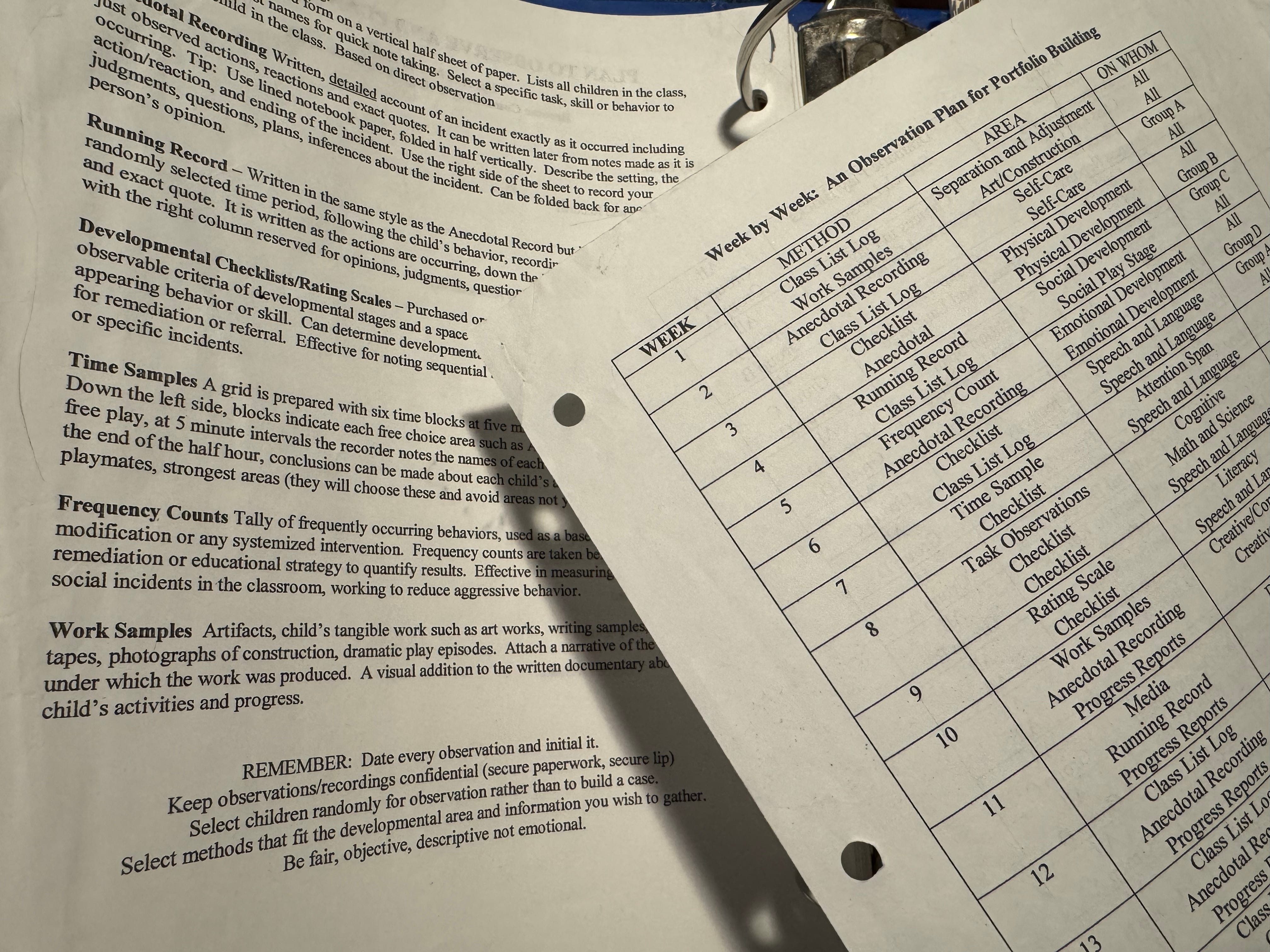
In college — both child development coursework as a silent observer and teacher education as a planning and instruction tool — I had been taught to use these many kinds of observation tools. Still, I felt overwhelmed by having to consistently observe all fourteen children in my care and make sense of what I was seeing. I couldn’t figure out how to get started.
I needed just a little structure, routines I could check off, as a new teacher in a necessarily busy toddler classroom. The conference session I lucked into gave me just enough habits to complete the required documentation — and then some.
And somewhere along the line, I truly fell in love with toddlers as I watched them, looking closely at their milestones and moments. And then, they taught me everything I know and everything I’ve needed to know.
The pace of the toddler room matches the amazing pace of development that happens in that year of life. A checklisty set of approaches gave me back my agency, but the meaning and purpose came from the toddlers. Making meaning as they were making meaning.
I’m just so lucky
So many people just “landed” in early care education. For so many of us, it wasn’t our ‘life plan’ to work in the lowest-paid profession in our country. But I’ll argue that, for whatever reason you landed in the toddler room, you, too, have probably had this kind of astounding luck.
A child makes meaning of something, and it begins to make meaning to you, again. Just like C did when she arrived at her conclusion about her bodily functions.
Because you, too, were a toddler once (and honestly, you still are).
When a friend mentions a book — read it. You might not need it right now, but the time might come.
When another friend has a baby — be open to the possibilities that arise.
When a learning opportunity presents itself — join it.
When it feels like the bottom — feel it.
When someone gives you a list of things to try — just try it.